Thursday, May 18, 2023

BOOKS by GEMINO H. ABAD, CARLOS BULOSAN, DOREEN FERNANDEZ, CRISTINA PANTOJA HIDALGO, VICENTE L. RAFAEL,

ALOYSIUSI POLINTAN provides Flash Reviews of 

The Promise of the Foreign: Nationalism and the Technics of Translation in the Spanish Philippines by Vicente L. Rafael 

(Ateneo de Manila University Press, 2005)


and


Sky Blue After the Rain: Selected Stories and Tales by Cristina Pantoja Hidalgo 

(University of the Philippines Press, 2005)

and

The Light in One’s Blood: Select Poems, 1973-2020 by Gemino H. Abad

(University of the Philippines Press, 2021)


and


Tikim: Essays on Philippine Food and Culture by Doreen Fernandez

(Anvil, 2020)


and


All the Conspirators by Carlos Bulosan

(Anvil, 2001)


and


MOTHERLESS TONGUES: The Insurgency of Language amid Wars of Translation by Vicente L. Rafael 

(ADMU Press, 2016)


and


Contracting Colonialism by Vicente L. Rafael

(ADMU Press, 1988)


The Promise of the Foreign: Nationalism and the Technics of Translation in the Spanish Philippines by Vicente L. Rafael


Flash Book Review No. 199: Of the three books I own by Vicente Rafael, I was able to finish this one first, probably because the dominant contexts presented in this book are the history topics most familiar to me—propagandists, heroes, and revolutions—as I was educated on Philippine history through textbooks and charts replete with names, dates, and places. Rafael's examination of translation (and its sub-technics and other events in colonial Philippines) as instrumental to the shaping of a people's identity and sense of nation, particularly in enabling Indios to aspire for freedom and independence, in whatever forms and means, heightened this fascination with nationalist movements in the 1890s. The foregrounding of scenes and characters in Rizal's novels Noli and Fili is a wise move in maintaining the benefits and drawbacks of translation while also stabilizing the motif of the following chapters. One of the reasons I'll keep reading his two other books and getting a copy of his other works is the way he paraphrases quoted texts from historical documents, which he did conscientiously, of course, towards extensive elucidation and the presentation of many alternative intepretations of the text at hand. What else could I want? This book is my prelude to the many splendored things to come as I equip myself with extensive knowledge on translation, which is more than just a ferrying over or a sort of linguistic task. Translation is a conscious act anchored on the desire for social mobility and, eventually, harmony, progress, and justice.

*

Sky Blue After the Rain: Selected Stories and Tales by Cristina Pantoja Hidalgo 


Flash Book Review No. 201: A superficial reader might overgeneralize Cristina Pantoja Hidalgo's fiction as abounding in middle-class, suburban settings or necessarily limited to socialite characters of Creole lineages. If one has to examine and dig deeper, magical realism—rendering quotidian lives with the sparkle and sprinkle of the fabulistic and speculative—is at the heart of her craft, as most especially sampled in Sky Blue After the Rain (UP Press, 2005). I have already been aware of some of the stories here, for I have read a few years earlier Catch A Falling Star and A Book of Dreams. And I reread them with the same excitement. It did not take me long to finish reading the book, for I had missed some fairy tales in my unmagical life. "How Bartolo Came to Be Called Bartolo" exemplifies Hidalgo's knack for giving complicated narratives a certain oneness supported by the most vivid of depictions. "The Pink Parasol" and "The Art of Understatement" stood out for their relatability in terms of characters and setting, leaving the reader contemplating each story's probable endings. "Kababayan" and "The Tree of the Perfect Plum" attest to the ever-urgent call for writing about our OFWs' homesickness and homeliness, as we question our sense of country and progress. The placement of "The Painting" at the collection's end is such a prudent choice because, for me, this story is a magnum opus, a story-within-a-story perfection, as it captures the effort and grace needed to pull off a plot that crosses over genres and dictions and to make the reader yearn for more. I believe this literary icon, whom I look forward to meeting again, will continue to dazzle more readers and inspire more young writers as they make their audience yearn for more. Regarding that "more," we owe it to our imagination.


*


The Light in One’s Blood: Select Poems, 1973-2020 by Gemino H. Abad


Flash Book Review No. 202: "[O]f flights and embraces—spindrift and daze," most of Abad's poems, particularly those included in this beautiful collection, are about searching for, celebrating, and becoming the light, and eventually raging against its dying. His style, his native clearing, gives young readers of poetry a glimpse of what's primeval and painstaking (but gloriously still) in a poet's pursuit of his sacred medium. I have always regarded my experience of reading the National Artist's verses as a technical exercise, an attempt to enrich my vocabulary and thus make language efficient, for through what other aspect of art can sense and substance be successfully evoked? And another question is raised: Who are we without our thoughts, our words? The poems under the "Self, Love, Family" theme are for me the most beautifully written, and it was Martin Scorsese who said: The most personal is the most creative. Giving tribute to people and events with the tool you hold dear and masterfully use is such a lovely thing! The line that captivates me is from the titular poem: "Proceed by evacuation / of first seeing: in emptiness / gather the pieces / of breaking light." Now that I'm finding it difficult to write a poem (perhaps a self-imposed hiatus), such a line has inspired me to gather the pieces one after another, as emptiness breaks away before me, the new year revealing its own revelry. I shall read on, then I shall write, until I have honed the promising craft, until the time when "Beauty was only the flame tree, Truth the overarching sky."


*


Tikim: Essays on Philippine Food and Culture by Doreen Fernandez


Flash Book Review No. 204: More than anything, the great Doreen Fernandez's Tikim: Essays on Philippine Food and Culture (Anvil, 2020) is such a big help in enriching my vocabulary in terms of food, flora and fauna, and the Filipino folkways, so that my future works—poems, fictions, and essays—would sound and be read as rooted and grounded in the Filipino consciousness as possible. This wonderful collection of columns, magazine contributions, and conference papers has also reinforced my long-term curiosity about Filipiniana, most of which is not available or accessible (an euphemism for "not affordable") in the province. "The study of food as culture within the context of colonization leads to an understanding of the fate of the local culture under hegemony of the dominant cultures of the colonizers." Fernandez's thorough and, of course, exciting study on Filipino food and culture is the product of not only collaborative research but also of a wealth of personal experiences and astute observations on the selection, preparation, consumption, and preservation of what's native and tinged with the foreign. How steaming and boiling in palayok and carajay constitute the "age-old praxis" of cooking, as well as how kinilaw exemplifies the "philosophy of freshness" subscribed by fisherfolk whose lone goal is surviving the day—all these are brought to light, as if light, even in the language of the kitchen, pertains to the hope that Filipino cuisine has never dwindled but only evolved. She confidently said, and this gave such hope a certain flavor: "Foreign food is adjusted to the local taste, and not vice-versa." What I also loved about this book is the attempt to balance the attention between the alta cocina Filipina and the cuisine we know as we traverse the streets, as we go about our daily grind and fast-paced lives. Reading every essay ends up with imagining a smorgasbord of mouth-watering dishes and delicacies, as if our taste buds have since time immemorial been archipelagic.


*


All the Conspirators by Carlos Bulosan


Flash Book Review No. 205: All the Conspirators (Anvil, 2001) is one of the few books I've read in one day for six hours straight, not because of its novella length but because of the thriller quality it promises. Every chapter concludes with a mysterious line that the eager reader hopes to discover as soon as possible. The new chapter is welcomed by a new character who will only complicate the plot further, leaving me to wonder who the conspirators are in that time of looting, hoarding, and connivance. Caroline Hau and Benedict Anderson's thorough introduction added to the excitement. The protagonist's intentions were questioned by strangers and even by himself, in the light of a country ravaged by the war, a country hunting for collaborators in every nook and cranny, across social circles. Carlos Bulosan's work piqued my interest after I read E. San Juan's Bulosan: An Introduction with Selections (one of the first books in my Flash Book Review series). In this book in particular, the great revolutionary writer depicted landscapes that still haunt our contemporary collective consciousness, places wrought by poverty, corruption, and the individual desire for power and long-term comfort. As told by a Filipino-American soldier returning home to solve a mystery that threatens his life, the narrative is familiar and has the potential for an action film adaptation, which can capture the hearts of low-income patrons while infuriating our modern-day balimbings and apologists.


*


MOTHERLESS TONGUES: The Insurgency of Language amid Wars of Translation by Vicente L. Rafael 


Flash Book Review No. 206: It takes a sharp, attentive mind to grasp what is at once strategically and euphoniously articulated, and it takes an effective author for me to immediately love all the themes at hand. I wish I could write like Dr. Vicente Rafael . I wish I had such a gift for elucidation. He mentioned this in his interview, which I believe encapsulates all of his undeniably important essays and papers on translation studies: "All I am doing is simply reminding people of a feature of translation that tends to get lost or submerged. It is that translation turns not just on the transfer of meaning but also on the struggle to control the processes of transferring meaning." Motherless Tongues: The Insurgency of Language Amid Wars of Translation (ADMU Press, 2016) reinforced the undeniable importance of his lifework. What distinguishes this book for me is its contemporaneity, not to mention the multiplicity of events and characters on display, without losing sight of translation as a companion of empire and an inviting arc for recognition of otherness. The three chapters on Anderson, Ileto, and Rosaldo, written in a lighter tone, contribute to the book's heartiness, if such a word exists. The second chapter was the most informative, as it elaborated on the vicissitudes of imposing American English on the minds of Filipinos across class divides against the backdrop of the scarcity of people fluent in Castilian (despite three centuries of Spanish colonization). Because of its lucidity and clear impact on potential readers, I actually utilized this chapter as the main reference for the students' final output in my Linguistics class.

*

Contracting Colonialism by Vicente L. Rafael

Flash Book Review No. 208: We use translation in order to communicate across linguistic boundaries and to be understood—this is what I teach as the basic function of the translating act. After I read the magnificent Contracting Colonialism (first published in 1988 by the ADMU Press) by the ever-eloquent Vicente Rafael , that piece of instruction is given a new light, rendered with so much richness that the transformative motive of my educational task has been reignited and therefore challenged. The extent of such a challenge was facilitated by the intrigues and alternating perspectives presented in the book, in which colonialism is seen as a byproduct, and eventually a companion, of a desire for comprehension. From the clear and careful examination of Tagalog texts such as prayers for the dying person and the sermon scene in Rizal's novel to the interesting reintroduction of the lives and motives of Tomas Pinpin, Gaspar Aquino de Belen, and the historians and missionaries between them, the book is surely a monumental step towards the growing appreciation of history and cultural criticism as tools for understanding the present effects of imperialism and nation-building in the face of globalization. Having read his other two books, The Promise of the Foreign and Motherless Tongues, I'm already a fan of Rafael's writings. If you are looking for a book as a leisure item, this may not be the one for you. This is an intense and complex work, and the experience of reading it is overwhelmingly enlightening. Once you've read it, you're no longer lingering in the dark. You'll yearn for spaces that are brighter.


*****

Since 2016, Aloysiusi Polintan has worked as a Senior High School Principal in Divina Pastora College. He started scribbling poems and essays when he was 17 years old. These poems are still kept in a notebook and wait to be revised for future publication. This notebook will be revived and will give birth to language already "lived." That is why his blog is named "Renaissance of a Notebook," a blog of poems, personal and academic essays, and flash movie reviews. His book reviews, which are published and featured in The Halo-Halo Review and Galatea Resurrects, are also to be found on the blog, under the series title "Mesmerized." He believes that the ability to judge or critique a literary piece starts with the reader's being moved and mesmerized by the artful arrangement of words articulating some longing for freedom and individuality. He's now working on a manuscript of 50 poems, with a working title of Brittle Sounds.


Wednesday, May 17, 2023

POST BOOK: LARA STAPLETON

The Halo-Halo Review is pleased to interview authors in the aftermath of their books’ releases. This issue features Lara Stapleton. 


What is your most recent book?

The Ruin of Everything, a short story collection published by Paloma Press (2021). 


What has been the response/what has surprised you most about the response?

The book was very nicely reviewed by a small amount of publications, one of which was The New York Times. Being reviewed by them was just stunning, and the review was both celebratory and somewhat snarky. The reviewer noticed something that I had not really put my finger on, that I write with poetic flashes. I suppose I knew that, but hadn’t identified it as a trademark element of my style, but I really enjoyed that and another review mentioned it also. I’m glad to be seen as having that unique signature. On one review I knew the writer hadn’t read my book but had gleaned some information from other reviews. Ha ha. It didn’t sell very well. I’m okay with that. I don’t let those kinds of things bother me. It took me so long to publish it, life has been challenging in other ways, I can’t be bothered to be hurt by that.  I was glad to get it out there, and Aileen Cassinetto, my publisher, of Paloma Press, was such a dream to work with, so supportive and easygoing.


Tell me something not obvious or known about the book.


Something I find kind of fun about the book is that the figure on the cover looks like me, but is not me! I found it on a website of Filipino-American artists, and I love the image, by Dr. Nanette Cacorda Catigbe. The woman is somewhat performative, maarte, she seems to be someone exaggerating her troubles, which matched perfectly to a somewhat self-pitying voice I use sometimes. I think it adds a layer of interpretation, post-modernist, and that she looks like me, and I name a character “Lara Stapleton,” is kind of incredible. I named a character after me to continue testing boundaries of characters, and for fun, really. It surprised me that people say I’m funny sometimes when I think I’m very heavy, but I’m glad they think so. 


What are you working on right now?


I haven’t really figured out how to explain this to my satisfaction yet, so for now, I’m going to say the novel I’m writing is about my friend Juan who passed away last year, and I’ll explain it by talking about him. He was the most incredibly loving person; everybody thought he was their best friend. He also had intense intimacy issues. He was an odd boyfriend and a skilled and agile friend. He had a New York accent like he grew up in Washington Heights but he was raised in Liverpool, born in Chile. He was very transparent, in the sense that his first priority in everything was to be loving, he expressed love all day long, but he had some strange secrets that came out after he passed. He was mostly friends with women, strange for a heterosexual man, I admire him for that, and he was extraordinarily kind and supportive, but a cagey and frustrating boyfriend, as I learned through my desire to commune with others who loved him after he passed. The novel is a way to continue carrying him with me. We became friends extremely gradually, and had only been close a few months before he died, but he was one of those people I was made high by knowing. I think perhaps I will say the novel is an argument that our extension of love can heal us much more than we believe, and that much suffering is made by the withholding of it, I think it’s a particular problem with New York’s competitive type-A intelligentsia, he was an antidote to that, but of course, not only in our circles. Also, I want to argue that we don’t have to be perfect to be loving. 


*****


Lara Stapleton was born and raised in East Lansing, Michigan, her maternal family is from the Philippines. New York City is her homeland. She is the author of two short story collections, The Ruin of Everything (Paloma Press) and The Lowest Blue Flame Before Nothing (Aunt Lute Press), an Independent Booksellers' Selection, and a Pen Open Book Committee Selection. She edited The Thirdest World (Factory School) and co-edited Juncture (Soft Skull). Her work has appeared in dozens of periodicals, including The LA Review of Books, Poets and Writers, The Brooklyn Rail, Ms., Glimmer Train, and The Indiana Review.


LOVE NOTES TO FILIPINO AUTHORS

This Feature presents readers sharing some love about the talent of Filipino writers and artists. We would welcome your participation. This section is for readers. You don't have to write "like a professional," "like a critic," "like an intellectual," "like a well-rounded reader," etc. Just write honestly about how you were moved. Live writers and artists (let alone the dead) don't get to hear enough from others who engage with their works (some may not even know all who comprise their audience). To know someone read their stories and poems or appreciated their artistry is to receive a gift. Just share from your heart. It will be more than enough. DEADLINE: Nov. 15, 2023 for Issue #16. Duplications of authors/artists and more than one testimonial are fine.


Mangozine's Issue #15 Presents

Eileen Tabios on Ina Cariño
Eileen Tabios on Hari Alluri
Elizabeth Ann Quirino on Claude Tayag, Michaela Fenix, and Ige Ramos
Leny Strobel on Gilda Cordero-Fernando
Eric Smith on Paolo Chikiamco and Mervin Alonzo

Eileen Tabios on Monica Macansantos

Leny Strobel on Patrick Rosal

Eileen Tabios on Patricia Manuel Go


Eileen Tabios on Ina Cariño

Ina Cariño's FEAST (Alice James Books, 2023) is a first book and contains not just achievements but much promise. The book drips as if its pages are stuffed with melted mantika, which is to say, what's not to love about melted butter since the drips to which I refer are lines wonderful enough to serve as epigraphs. Like,


“archipelago is just another word / for slaughtered”

—from “Yesterday’s Traumas, Today’s Salt”


”wounds pretending to be badges from war”

—from “Shingles”


“slice through the fattest layer in your gut      & eat”

—from “Lean Economy”


As one can see by the above lines, FEAST does not exclude the bitter, and it's a stronger collection for it. I relished several moments, such as this beginning to "Piyesta":

“surrendering to a new tongue

            is having mine sliced

                                                on the jag of expectation”


Yes, FEAST encourages seconds for reading again through its pages. Cariño makes poison even delicious to read—their (or a) version of poetry's beautiful paradox.


Eileen Tabios on Hari Alluri


You know that thing many readers of poetry books do, which is to open the book at random to read individual poems? I rarely do that for the first read because I am also interested in the construction of the poetry book—how it’s ordered, how it’s sectioned, how its beginning poem might relate to its last poem, how flabby it’s middle section may or may not be, and so on. While Hari Alluri’s The Flayed City (Kaya Press, 2017) excels on such construction issues, it also shows why so many readers read individual poems at random. All the pages, the poems, are individually worthwhile reading even if they were not comprising a book. One can test my opinion by me opening the book at random and sharing poems. Here’s one example:

This war recast

her city’s lines—the threads

she bound her broom with.


Here’s another:


Until I read Hari Alluri, I’d never before combined the words/concepts of “gritty” and “luminous"—a stellar achievement.

*

Elizabeth Ann Quirino on Claude Tayag, Michaela Fenix, and Ige Ramos


“The only correct way to cook adobo is the one you grew up with.”- Chef Claude Tayag.

In this 200-page, full color, 9 x 9-inch coffee-table book entitled The Ultimate Filipino Adobo: Stories through the Ages by Claude Tayag, with Michaela Fenix and Ige Ramos, one finds the answer to the age old question of “who cooks the best adobo.”

This compendium of adobo essays by culinary experts was published in 2022 by The Foreign Language Institute (Manila). Told through family stories, and via historical origins, one discovers there is no one way, and there is no standard, strict rule to cook the Philippines’ unofficial national dish. 

This thick, rich book of adobo anecdotes affirms what the reader feels: the joys, the exhilaration, the ultimate feeling of satisfaction that never ends when one tastes the flavors of that savory, tart, vinegary, and garlicky dish right next to a bowl of steamed rice. As to which is the best adobo? The authors suggest it’s the one in your kitchen, in the heart of your home.

“It’s the feel-good memory of home no matter where their paths may have taken them, that makes the Filipino adobo truly a treasured dish.” – from The Ultimate Filipino Adobo Book.

*

Leny Strobel on Gilda Cordero-Fernando

This is a very belated love note to Gilda Cordero-Fernando because her Jamming on an Old Saya (Anvil, 1995) is one of a few coffee-table books that I've kept. Somehow this book reminds me of the current flowering of interest in all things Filipino indigenous as well as cultural practices in the diaspora—in fashion, film, literature, and food. Jamming on an Old Saya reminds me that what is "old/antique" can be made new again and speak to a new generation. An old saya, panuelo, or tapis languishing in old trunks can become refashioned into something new again. GCF was that kind of visionary. She was known as the one who opens the door, a pacesetter.  

I wish others can see the beauty of this book! But it is out of print. It should be reprinted!


*

Eric Smith on Paolo Chikiamco and Mervin Malonzo


The Philippines is an archipelago nation of more than 7000 islands and almost 200 ethnolinguistic communities. The diversity of indigenous cultures has led to a vast pantheon of gods, goddesses, and other deities, heroes, monsters, and creatures. The number of myths and legends from the Philippines is unfathomable. Throughout the centuries, the stories have transformed and developed. Many stories still continue to change with the times.

Alternative Alamat: An Anthology (Tuttle Publishing, 2022) is curated and edited by Paolo Chikiamco. In its third edition, it’s the first publication in English. Alamat is the Filipino word for legend, making this book a collection of new stories of Filipino mythology. As a non-Filipino reviewer, I was drawn to this book because of my interest in the non-western folklore. These unique renditions, sometimes keeping up with the modern age, do not disappoint. The legends come from thirteen different Filipino authors. Some are known to western audiences, like Budjette Tan, the creator of the Trese series. In addition to the tales, this book offers expert interviews, a glossary of notable deities, and even a comic strip. For readers who know the stories, this book provides a fresh new look at some old characters. For readers seeing these tales for the first time, it’s a great launch pad into the unique and fascinating realm of Filipino folklore.  

*

Eileen Tabios on Monica Macansantos


LOVE AND OTHER RITUALS (grattan street press, Australia, 2022) is Monica Macansantos' first (I believe it’s her first?) short story collection,  is aptly titled since I consider the title story “Love and Other Rituals” to be a standout in this particular company. Not that there’s anything wrong with the other stories. Ultimately, I got a sense as I read through the book of coming across a writer who’s early on in what looks to be a promising literary career. Her promise was emphasized by a particular sentence that made me linger in contemplation—here's the sentence:

“There was nothing left to do but stand at a distance; that desire to rework things in the mind, he realized, was a waste of time.”

Sometimes, you—or I—read certain books and a single sentence can make entire books worthwhile. I’d place the above sentence in that category. This sentence made me pause, not just to admire it. In such a sentence, I see the potential for a novel, more than one novel, as the writer shows she possesses the powers of observation, (self-)awareness, meditation, and analysis that are necessary atop good writing skills to make a great novelist. I do consider her potential scale to be larger than the short story—in a way, I feel like some short stories were longing for longer forms.


It's possible I gleaned that longing too subjectively as a response to the pacing of the book’s stories. These stories require intent attention from readers if they want to appreciate them, i.e. they don’t work for quick or flip-reads. In fact, because of pacing, at one point I was reminded of Wong Kar-wai’s 2000 drama In the Mood for Love praised for its lush, gorgeous scenes and subtle, evocative storytelling. May she hone her skill for the evocative in the years ahead of her writing. 


For now, and as I return to re-read the story “Leaving Auckland” that I feel warrants more than one reading to fully appreciate, I recommend Monica’s book, a validation of the short story form.

*

Leny Strobel on Patrick Rosal


When I came across Patrick Rosal’s ATANG: An Altar for Listening to the Beginning of the World (Quili-Quili Press, 2021), a flash of recognition engulfed me. This “self-published book improvisation” by Quili-Quili Power Press makes me laugh. Dear reader, you do know that word, right? It’s one of the first words we teach our kids when we want them to pick up a Pilipino word for their body parts. Your kili-kili stinks!! We kiss the baby’s kili-kili and we gigil!!

“500 years of making shit up as we go along” — Patrick Rosal. In ATANG, Patrick makes up all the shit that isn’t shit and plays with historical events triggering memories, ghosts and haunting, ancestral imprints, diasporic stories — and everything comes alive for me. YES! I shout silently. This is what I miss! This is what I’ve always wanted to see emerge: the blurring of genres, boundaries and maps…and still what I get in the end is the clarity of transfiguration. A Love beyond the page. A Joy beyond language. Kapwa.

But how can your father be a priest, Patrick? Priests are supposed to be celibate. I’m glad he fell in love with your mother. Maybe St Augustine or Francis Aquinas did their bidding on his lonely heart. That is Blessedness because you are here now. Another peal of silent laughter as I read about your convoluted family history. The fatherpriest you didn’t want to be and so you didn’t become one. Yes, all of our family histories are convoluted. How can they not be? Everything is convoluted from the beginning. Here you are now fathering from quili-quili power! Bringing many children into the fold and gold of your mythic imagination.

As you are much younger than I am, I couldn’t relate much to the pop culture you grew up in: turntables and djing and punk and hip hop — and yet I feel the pulse of these energies. They are shamanic. They are ontological and chthonic as they say in academic jargon. Of the underworld. Subversive. Emergent. Our people are good at these kinds of shit even when they think it’s because of their devotion to the Sto Nino.

I like the parts of ATANG where you write about your struggle with tinnitus, the uninvited sounds of crickets 24/7 drowning out conversations; the mixtape they create in our heads. For you, it is a reminder of what our navigator ancestors must have learned from listening to the waves of the ocean. Sound as Teacher. You make me believe that we still have those skills or can regenerate these skills if we know the power they carry. If we get to know our bodies.

Perhaps this is why you have included Language lessons in Ilokano in ATANG. I am not Ilokano so picking up new words in Ilokano makes me feel connected to what the words carry: Rebbeng, Dungaw, Manganup, Mangisuro. I can hear the affinity of Austronesian languages. Marian Pastor Roces, museum curator and art and cultural critic, urges us to always think beyond the 500 years of colonial history and get to know our five thousand year old Austronesian history and cultures. You are doing this here and Ilokano works its magic.

NVM Gonzalez, our national artist for literature, once told me: “Leny, for what you want to do, there is no language; learn how to sing, dance, paint instead.” Your drawings and collages remind me of this, Patrick. Because English is a borrowed tongue and hardly adequate to translate our sensibilities, we draw and make art. Thank you for keeping records this way.


*

Eileen Tabios on Patricia Manuel Go

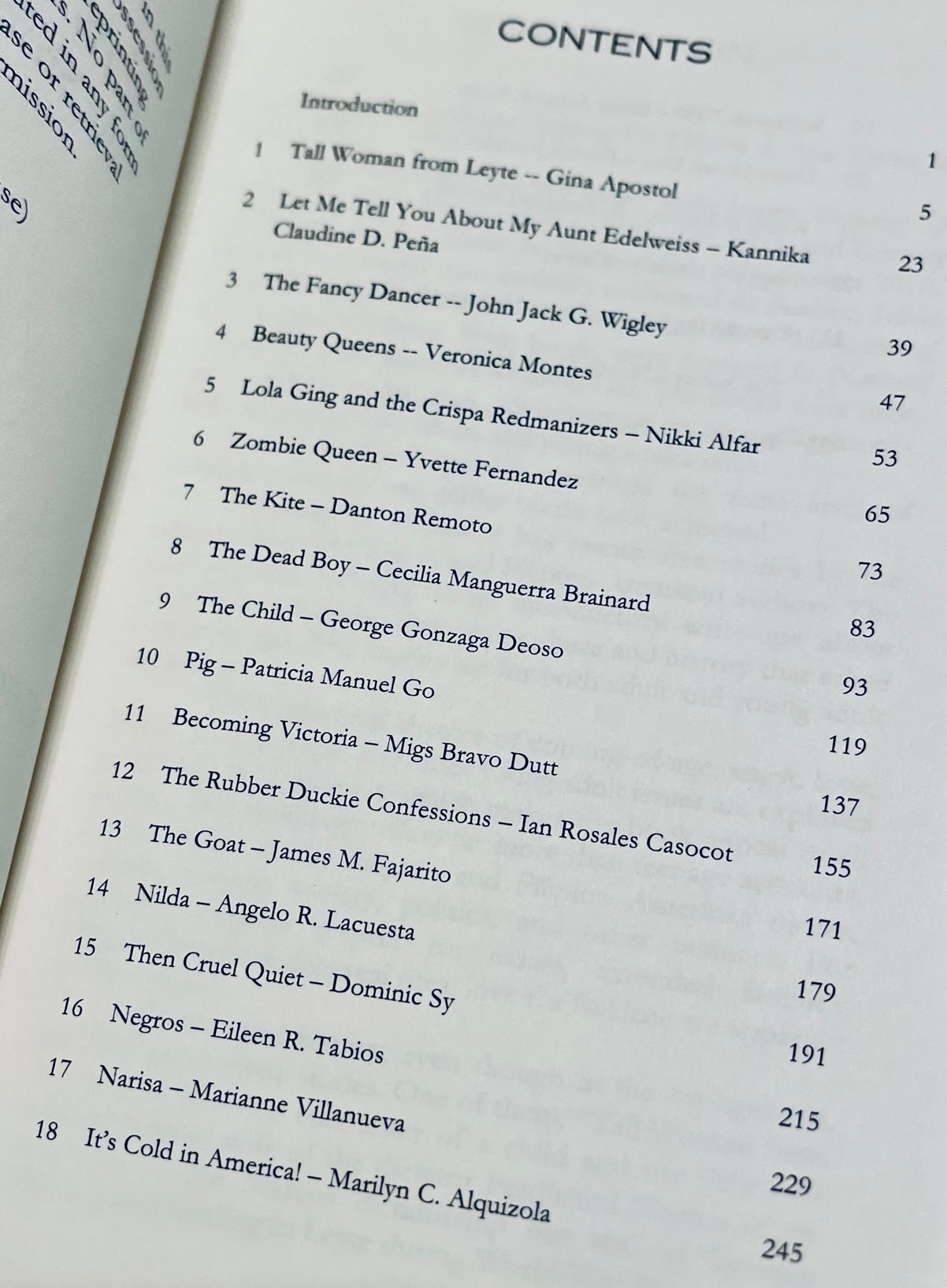
GROWING UP FILIPINO 3, edited by Cecilia Brainard and published in the U.S by PALH, is an anthology of short stories by Filipino/x writers. I truly enjoyed the stories of such writers as Gina Apostol, Angelo R. Lacuesta, and Brian Ascalon Roley, but since they and others in the anthology are experienced, well-known writers, I'm mostly excited to say I sincerely appreciated the story "Pig" by a writer unknown to me: Patricia Manuel Go. Patricia's story was a stand-out for me. Imagine my doubled delight when, in reading her bio, I learn that she started writing just last year and that "Pig" is her first published story! Well, this first publication held up well in its company and I hope she continues writing and that I am able to read more by her soon in the future!
Meanwhile, yes, this anthology of Filipino/x short stories is one that should belong on the shelves of literature lovers but also shelves in all Filipino homes across the world--I encourage you to make it so! (And thank you to the indefatigable editor Cecilia M. Brainard!)